Copyright © 2026
Rashid Visda. All rights reserved.
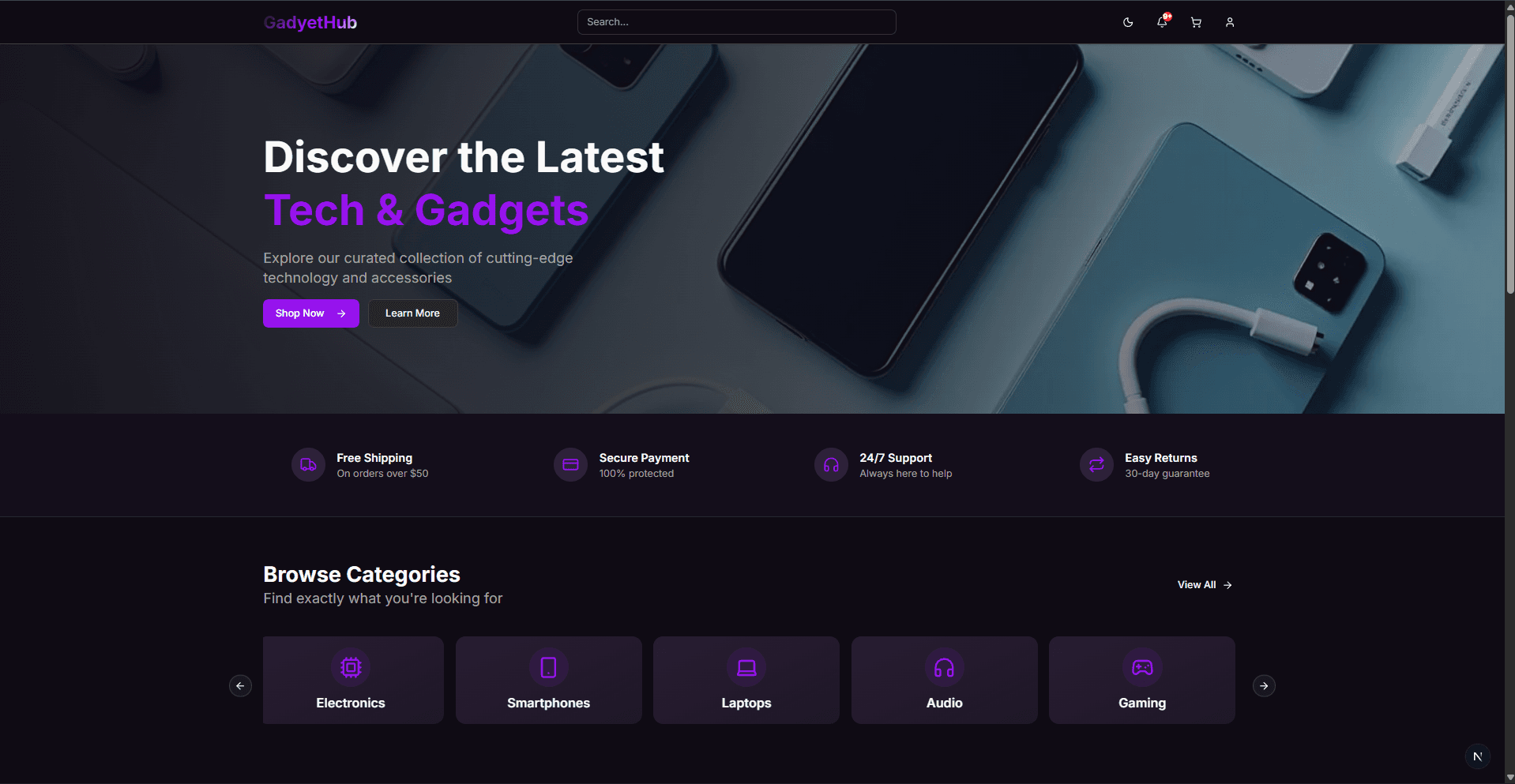
A full-stack e-commerce app for tech products with user auth, product filtering, cart, and a role-based access system for admins.
chartjs lucide-react motion nextjs radix-ui
GadyetHub
What this project does
A modern e-commerce marketplace platform for electronics and accessories, built with Next.js, TypeScript, and Supabase. It provides both a customer‑facing storefront and an admin dashboard, complete with authentication, product management, order workflows, and a responsive dark/light UI.
Live demo: https://gadyet-hub.vercel.app/
Why it’s useful
This starter kit is intended for developers who want a working, full‑stack e‑commerce example using the latest Next.js features. It can be used as:
A learning resource to understand client/server integration with Supabase
A foundation for launching your own store or adapting to other domains
A reusable template with authentication, admin tooling, and real‑time updates
Table of Contents
Key features
Customer-Facing Features
Responsive Design – Navbar on desktop, collapsible sidebar on mobile/tabletProduct Browsing – Browse products by category with detailed product pagesShopping Cart – Add items to cart and manage ordersOrder Management – View and track your ordersNotifications – Real-time notifications and alertsForgot Password – Reset your password via email link for account recoveryDark/Light Mode – Theme toggle for user preference
Admin Dashboard
Dashboard Overview – High-level business metrics and KPIsOrders Management – View, filter, and update order statusesInventory Management – Add, edit, and delete products; manage stock levels
react
shadcn
supabase
tailwindcss
typescript
zustand
User Management – View and manage customer accounts
Notifications Panel – Monitor system events and alertsAuthentication & Authorization
Email/password authentication via Supabase Auth
Role-based access control (Customer / Admin)
Session persistence with secure cookies
Protected routes and API endpoints
Tech Stack
Prerequisites Before you begin, ensure you have the following installed:
Node.js v18+ or v20+ (Download )npm or yarn (comes with Node.js)Supabase Account – Sign up free Git for version control
Installation
Clone the repository
git clone https://github.com/zidvsd/gadyethub.git
cd gadyethub
Install dependencies
npm install
yarn install
Environment Setup Create a .env.local file in the root directory with your Supabase credentials:
NEXT_PUBLIC_SUPABASE_URL=your_supabase_url
NEXT_PUBLIC_SUPABASE_ANON_KEY=your_supabase_anon_key
SUPABASE_SERVICE_ROLE_KEY=your_service_role_key
Getting Supabase Credentials
Go to Supabase Dashboard
Create a new project or select existing one
Navigate to Settings → API in the sidebar
Copy:
Project URL → NEXT_PUBLIC_SUPABASE_URLAnon key → NEXT_PUBLIC_SUPABASE_ANON_KEY
Add these values to .env.local
Database Setup The application expects the following Supabase tables:
users – Customer and admin profilesproducts – Product catalog with name, price, stock, image_pathorders – User orders with status and total_priceorder_items – Line items linking orders to productsnotifications – Stores messages shown to users (used by the real-time alert system) Refer to your Supabase database schema documentation or create tables using the SQL Editor in your Supabase dashboard.
Running Locally
Start Development Server
Build for Production
Run Linter
Project Structure gadyethub/
├── app/ # Next.js App Router
│ ├── (auth)/ # Auth routes (login, signup)
│ ├── (withSidebar)/ # Customer routes with navbar/sidebar
│ │ ├── cart/
│ │ ├── inbox/
│ │ ├── products/[category]/
│ │ └── page.tsx # Home page
│ ├── admin/ # Admin dashboard (protected)
│ │ ├── dashboard/
│ │ │ ├── inventory/ # Product management
│ │ │ ├── orders/ # Order management
│ │ │ ├── users/ # User management
│ │ │ ├── notifications/
│ │ │ └── page.tsx
│ │ └── settings/
│ ├── api/ # API Routes
│ │ ├── admin/ # Admin endpoints (protected)
│ │ │ ├── orders/
│ │ │ ├── products/
│ │ │ └── users/
│ │ ├── auth/ # Authentication endpoints
│ │ │ ├── login/
│ │ │ └── signin/
│ │ ├── client/ # Customer endpoints
│ │ │ ├── orders/
│ │ │ └── user/
│ │ └── products/ # Public product endpoints
│ ├── layout.tsx # Root layout with Footer
│ ├── globals.css # Global styles
│ └── page.tsx # Root page
├── components/
│ ├── AppSidebar.tsx # Navigation sidebar
│ ├── client/
│ │ └── Navbar.tsx # Top navigation bar
│ ├── admin/
│ │ └── ProductsList.tsx # Admin product list
│ ├── ui/ # Reusable UI components
│ │ ├── button.tsx
│ │ ├── card.tsx
│ │ ├── table.tsx
│ │ ├── sidebar.tsx
│ │ └── ...
│ └── Footer.tsx # Site footer
├── hooks/
│ └── use-mobile.ts # Responsive design hook
├── lib/
│ ├── supabase/
│ │ ├── client.ts # Client-side Supabase client
│ │ ├── server.ts # Server-side Supabase client
│ │ └── session.ts # Session utilities
│ ├── types/
│ │ ├── orders.ts # Order TypeScript interfaces
│ │ └── products.ts # Product TypeScript interfaces
│ ├── layoutMenus.tsx # Navigation menu definitions
│ └── utils.ts # Helper functions
├── store/
│ ├── useOrders.tsx # Zustand orders store
│ └── useProducts.tsx # Zustand products store
├── public/ # Static assets
├── next.config.ts # Next.js configuration
├── tailwind.config.ts # Tailwind CSS configuration
├── tsconfig.json # TypeScript configuration
└── package.json # Project dependencies
API Routes
Products (Public)
GET /api/products – Fetch all productsGET /api/products/[id] – Fetch single product
Admin Routes (Protected)
GET /api/admin/orders – Get all ordersPOST /api/admin/orders – Create orderGET /api/admin/orders/[id] – Get order detailsPATCH /api/admin/orders/[id] – Update orderGET /api/admin/products – Get productsPOST /api/admin/products – Create productPATCH /api/admin/products/[id] – Update productDELETE /api/admin/products/[id] – Delete productGET /api/admin/users – Get all usersGET /api/admin/users/[id] – Get user details
Customer Routes (Protected)
GET /api/client/orders – Fetch customer's ordersPOST /api/client/orders – Create orderGET /api/client/orders/[id] – Fetch order detailsGET /api/client/user – Fetch user profile
Authentication
POST /api/auth/login – Login with email/passwordPOST /api/auth/signin – Sign up new accountPOST /api/auth/forgot-password – Request password reset emailPOST /api/auth/reset-password – Submit new password using reset token
Development
Key Technologies & Patterns
Server components by default; use "use client" for interactivity
Reusable UI components from components/ui/
Custom hooks in hooks/ for shared logic
Zustand stores (store/) for products and ordersLocal state (React hooks) for form handlingSupabase real-time for live updates
Tailwind CSS for utility-first styling
CSS modules for component-specific styles (if needed)
Dark mode support via Next Themes
Full TypeScript support
Type definitions in lib/types/
Strict mode enabled
Common Development Tasks
Create file in app/(withSidebar)/ or app/admin/
Use route-specific layout or create custom layout
Import components and data as needed
Create file in app/api/<scope>/
Export async handler (GET, POST, PATCH, DELETE)
Use requireAdmin() utility for admin routes
Return standardized response: { success: boolean, data?: any, error?: string }
Create file in components/
Use Radix UI components for headless UI
Import Lucide icons for consistent iconography
Add TypeScript props interface
Fetch data from Zustand store
import { useProducts } from "@/store/useProducts" ;
export default function MyComponent (const { products, loading, error, fetchProducts } = useProducts ();
useEffect (() => {
fetchProducts ();
}, []);
return <div > {/* render products */}</div >
Contributing Contributions are welcome! Please follow these guidelines:
Fork the repositoryCreate a feature branch: git checkout -b feature/your-featureCommit your changes: git commit -m 'Add feature'Push to your branch: git push origin feature/your-featureOpen a Pull Request with a clear description
Code Style
Use TypeScript for new code
Follow ESLint rules: npm run lint
Use Tailwind CSS for styling
Keep components focused and reusable
Add JSDoc comments for complex logic
Support & Documentation
License This project is licensed under the MIT license. Add a LICENSE file with the MIT text or contact the maintainer.
Built with Next.js, React, and Supabase.